Sunday, August 21, 2011
RIZALPABETO
RIZALPABETO is a collaboration between artist Elmer Borlongan and poet Vim Nadera. In this pioneering exhibit, Emong uses the iPad as his medium to bring Vim's poems celebrating the life and legacy of Philippine National Hero Jose Rizal to life.
Curated by J. Pacena, CANVAS will showcase a "teaser" exhibition of Rizalpabeto at ManilArt 2011 from August 24-27, 2011 at the NBC Tent, Bonifacio Global City.
Rizalpabeto will be launched as a children's book, and as signed limited edition giclee prints (edition size: 5) in October. If interested in reserving prints, please email info@canvas.ph.


Friday, August 12, 2011
KULO IN BLACK AND WHITE

Conrado de Quiros wrote, the issue is "complicated." We don’t agree. We think it’s possible to frame most of the issues in black and white terms that are answerable by yes or no.
1. The artwork was offensive. There is no debate there. Deliberate or not, it was not only incendiary, but foreseeably incendiary.
2. Mideo Cruz had every right to make his artwork. That it offends did not diminish his right.
3. The freedom of religious exercise is irrelevant here. No one is preventing anyone from exercising his or her religion.
4. That the artwork was offensive or disgusting does not make it any less an artwork. When do you call something art? Answer: when the person who made it says it is. The gray area is whether it is good art or bad art. If Mideo says it’s art, then it is. Everyone else is free to decide whether they like it (It’s good!) or not (It's bad!).
5. Horrendous art does not justify horrendous deeds. When the Inquirer says that the violence inflicted on the exhibit is “understandable”, we only hope they mean they could understand why someone would be driven to such extreme measures. But violence against art and artists (or anyone else with something to say, for that matter) is never justified. Not even in the defense of one’s faith.
6. Was the CCP wrong to host the exhibit? There is no black and white answer for this one.
If it were a private venue, then the answer would be clear - No, it was not wrong. It is free to host any art exhibition that it wants (subject of course to existing laws to protect minors - but in such cases, the appropriate response would be to regulate the attendance but not to ban the show).
But this is a public institution, utilizing public funds. So the question is quite murky. On the one hand, the CCP is charged with fostering the development of art in the country, which would inevitably involve hosting art on the edge such as Kulo (it is important to note that Mideo’s piece was just one among many). On the other hand, as a public institution, it cannot and should not ignore the sensitivities of the public.
The CCP needs to balance these sometimes competing concerns, and if there is anything to be learned from this unfortunate incident, it is that the CCP must have a clear and transparent policy on what it can or cannot host within its halls. Only with such a policy in place can artists know how far they can go when they exhibit their works at the CCP, and in this manner, the CCP also insulates itself from charges of censorship (because the artists would remain free to exhibit their works elsewhere).
Only with clarity can we avoid similar problems as this one.
7. Was the CCP wrong to close the exhibit? Yes, it was.
There is a difference between refusing to host an exhibit because of public policy considerations from the onset versus closing down an exhibit because of a public outcry over its content.
The former is a valid exercise of prudence and mandate. The latter is a capitulation to a mob. The CCP should have stood its ground and fulfilled its duty, and the closure was therefore a shameful defeat for the right of free expression.
To view exactly what was closed down, please click here.
Monday, August 8, 2011
A Teaching Moment on Free Expression
In a probably biased (we are on the side of the Cultural Center of the Philippines on the well publicized controversy, after all) attempt to make the most of this teaching moment, allow us to submit these questions for your reflection and consideration.
1. Why is burning an effigy of our president not considered offensive or criminal? Is it not meant to provoke and attack? Is it not an act of gross disrespect for an important figure of authority? Should such acts now therefore be banned?

2. If that doesn't cross the line, what about burning the president in effigy AND burning a truly important cultural and patriotic symbol like the flag?
We do have a law prohibits acts "[t]o mutilate, deface, defile, trample on or cast contempt or commit any act or omission casting dishonor or ridicule upon the flag or over its surface." We went to google to see if we could find any examples or pictures of someone burning the Philippine flag and - to our surprise and pride - came up empty. But this one's close enough:
 In the US, flag burning is recognized as a legitimate expression of protest. As far as we know, the law banning the mutilation and defacement of the Philippine flag has not been tested in court against the Constitutional right of free speech.
In such a test, on which side would you stand?
3. In an opinion piece, the Philippine Daily Inquirer wrote that
(t)he danger here is that his art could become arrogant and terror-prone. The Church has experienced a tumultuous history of iconoclastic revolutions across the centuries (the Byzantine iconoclastic outbursts in the first millennium and the Protestant revolts in the second) that have destroyed priceless items in man’s cultural heritage.
The question is, so what?
Isn't art and music and words sometimes legitimately arrogant and terror-prone? Isn't arrogant and terror-prone art still free speech?

Where would our country be if Rizal had written Noli, or if our legislators had succumbed to similar Church-led pressure against the Rizal bill?
4. Who's to say what's art or what's not art?
Is this painting art? Is it merely disdainful, or did it cross some line that makes it scandalously disrespectful and blasphemous?
 Mga May Akda
by Manny Garibay
Oil on canvas (2007).
(Disclosure: From where we sit, we like it. We liked it enough to acquire for our permanent collection. )
5. Finally, given the chilling effect that has been imposed with blunt force on the Cultural Center of the Philippines and on the participating artists, who in the creative sector now will dare use their work to question the powers that be?
Regardless of where you stand on this particular exhibit, is it really worth it to set this precedent?
Saturday, July 16, 2011
Updates, updates and more updates!
Sorry, it's been a while since our last post. It's just so much easier to update using Facebook, but a lot of the details are often lost in the flurry of feeds.
So here goes...
 The BIG news is that we will be hosting TEDxDiliman here in the Philippines this coming October. It's a half-day event where speakers will share their BIG ideas on "How Art and Culture Can Change Our World."
We have a great line-up of speakers and performers already confirmed: Glecy Atienza (theater), Noel Cabangon (music), Gloc9 (music), Lourd de Veyra (new media), Rico Gutierrez (TV), Fernando Sena (visual arts), John Silva (visual arts/museums), Aureus Solito (film) and Nina Yuson (children's advocacy/museums). Kenneth Cobonpue (design) has expressed strong interest but still has to work out his very busy schedule, and we're also talking with Patricia Evangelista (media/TV). And we have a few surprises up our sleeve that we know (hope) will blow you away.
TEDxDiliman happens on October 8, 2011 at the UP College of Law from 1:30-7pm. Seating, unfortunately, is very limited (our license from TED is capped at 100 guests). To apply for a ticket, please click here.
We expect interest to far exceed the number of people we can accommodate, so our apologies in advance to those who won't be able to get in. But we are working on doing a live streaming of all the talks and performances so people can still join us on the web.
 Then, there's this small Coloring Book Project that we're working on. We invited a few artists to submit pen and ink drawings that we will sell, and proceeds used to produce a children's coloring book based on the sketches. CANVAS will then publish (we're thinking of an initial print run of 5,000 copies) and donate these coloring books to children's hospitals and public schools.
To ensure full accessibility and affordability, the drawings will also be made freely downloadable on a webpage that we will create, in the hope that OFWs and teachers will find them useful as they teach their children/students about the Philippines.
So who's participating? Ahem, two National Artists (Bencab - that's his sketch on top, and Abdulmari Imao) to start. And a few other notables and emerging artists - Leonard Aguinaldo, Daniel Aligaen, Angel Antonio, Mark Arcamo, Norma Belleza, Plet Bolipata, Elmer Borlongan, Serj Bumatay, Marika Constantino, Farley del Rosario, Ferdinand Doctolero, Liza Flores, Manny Garibay, Mark Justiniani, Raymond Legaspi, John Lock, Joy Mallari, J. Pacena, Beth Parocha, Iggy Rodriguez, John Santos, Pam Yan Santos, and Palma Tayona. Puede na. :-)
Meanwhile, in case you missed it, we did get into Global Giving (thanks to and for your support!), and we're nearly set to publish an anthology of our first three stories: Elias and His Trees, The Rocking Horse, and Sol - A Legend About the Sun.
Just like the coloring book, we will publish the first volume of CANVAS Collection and work with partners to donate them to children, public schools and hospitals all over the Philippines. You can still help by clicking here, and donating through Global Giving.
Both books will launch in October, hopefully getting distributed in time for Christmas.
Those aren't the only books we're publishing in the coming months.
 At the end of September, our next original children's book, Tahan Na, Tahanan by Issa Alarilla-Arellano, with artworks by Don Salubayba, will be on deck. The new book will launch simultaneously with a solo exhibition by Don at the Ayala Museum.

Following that, and again in October, we will launch RIZALPABETO, a unique (in many ways) alphabet book born from the collaboration of poet Vim Nadera and artist Elmer Borlongan who will use iPad sketches to bring Vim's poetry to life.
As a preview, above is Elmer's iPad sketch for the letter G - for Gomburza, and below is an excerpt of Vim's poetry for it.
The sketches and poetry will be on display in a multimedia exhibition curated by J. Pacena that we will host at our Manilart booth this August. We're very excited (and anxious) to see how it will be received. :-)
And there's more...
 "Untitled" by Issay Rodriguez. Oil on canvas (2011).
At the Looking for Juan Art Space in Serendra, we have Mamihlapinatapai, a group show by UP Fine Arts students Alee Garibay, Clara Herrera and Issay Rodriguez opening this Monday (July 18, 2011).
Exhibitions by Lina Ciani, Buddy Ching, Anton Balao and Jim Orencio, among others are also scheduled for the rest of the year.
We're going to have a lot of fun in this second half of 2011. We're also going to need your help... there will be lots of opportunities for you to be involved. We will keep you posted. :-)
So here goes...
 The BIG news is that we will be hosting TEDxDiliman here in the Philippines this coming October. It's a half-day event where speakers will share their BIG ideas on "How Art and Culture Can Change Our World."
We have a great line-up of speakers and performers already confirmed: Glecy Atienza (theater), Noel Cabangon (music), Gloc9 (music), Lourd de Veyra (new media), Rico Gutierrez (TV), Fernando Sena (visual arts), John Silva (visual arts/museums), Aureus Solito (film) and Nina Yuson (children's advocacy/museums). Kenneth Cobonpue (design) has expressed strong interest but still has to work out his very busy schedule, and we're also talking with Patricia Evangelista (media/TV). And we have a few surprises up our sleeve that we know (hope) will blow you away.
TEDxDiliman happens on October 8, 2011 at the UP College of Law from 1:30-7pm. Seating, unfortunately, is very limited (our license from TED is capped at 100 guests). To apply for a ticket, please click here.
We expect interest to far exceed the number of people we can accommodate, so our apologies in advance to those who won't be able to get in. But we are working on doing a live streaming of all the talks and performances so people can still join us on the web.
 Then, there's this small Coloring Book Project that we're working on. We invited a few artists to submit pen and ink drawings that we will sell, and proceeds used to produce a children's coloring book based on the sketches. CANVAS will then publish (we're thinking of an initial print run of 5,000 copies) and donate these coloring books to children's hospitals and public schools.
To ensure full accessibility and affordability, the drawings will also be made freely downloadable on a webpage that we will create, in the hope that OFWs and teachers will find them useful as they teach their children/students about the Philippines.
So who's participating? Ahem, two National Artists (Bencab - that's his sketch on top, and Abdulmari Imao) to start. And a few other notables and emerging artists - Leonard Aguinaldo, Daniel Aligaen, Angel Antonio, Mark Arcamo, Norma Belleza, Plet Bolipata, Elmer Borlongan, Serj Bumatay, Marika Constantino, Farley del Rosario, Ferdinand Doctolero, Liza Flores, Manny Garibay, Mark Justiniani, Raymond Legaspi, John Lock, Joy Mallari, J. Pacena, Beth Parocha, Iggy Rodriguez, John Santos, Pam Yan Santos, and Palma Tayona. Puede na. :-)
Meanwhile, in case you missed it, we did get into Global Giving (thanks to and for your support!), and we're nearly set to publish an anthology of our first three stories: Elias and His Trees, The Rocking Horse, and Sol - A Legend About the Sun.
Just like the coloring book, we will publish the first volume of CANVAS Collection and work with partners to donate them to children, public schools and hospitals all over the Philippines. You can still help by clicking here, and donating through Global Giving.
Both books will launch in October, hopefully getting distributed in time for Christmas.
Those aren't the only books we're publishing in the coming months.
 At the end of September, our next original children's book, Tahan Na, Tahanan by Issa Alarilla-Arellano, with artworks by Don Salubayba, will be on deck. The new book will launch simultaneously with a solo exhibition by Don at the Ayala Museum.

Following that, and again in October, we will launch RIZALPABETO, a unique (in many ways) alphabet book born from the collaboration of poet Vim Nadera and artist Elmer Borlongan who will use iPad sketches to bring Vim's poetry to life.
As a preview, above is Elmer's iPad sketch for the letter G - for Gomburza, and below is an excerpt of Vim's poetry for it.
... Kaya nang may nag-aklas sa arsenal sa Kabite
Sina Padre Gomez, Burgos, at Zamora ay huli.
Tatlong martir silang sa Bagumbayan ginarote
Ang sa mitsa ng pagkamakabayan ko ang nagsindi.
Sina Padre Gomez, Burgos, at Zamora ay huli.
Tatlong martir silang sa Bagumbayan ginarote
Ang sa mitsa ng pagkamakabayan ko ang nagsindi.
The sketches and poetry will be on display in a multimedia exhibition curated by J. Pacena that we will host at our Manilart booth this August. We're very excited (and anxious) to see how it will be received. :-)
And there's more...
 "Untitled" by Issay Rodriguez. Oil on canvas (2011).
At the Looking for Juan Art Space in Serendra, we have Mamihlapinatapai, a group show by UP Fine Arts students Alee Garibay, Clara Herrera and Issay Rodriguez opening this Monday (July 18, 2011).
Exhibitions by Lina Ciani, Buddy Ching, Anton Balao and Jim Orencio, among others are also scheduled for the rest of the year.
We're going to have a lot of fun in this second half of 2011. We're also going to need your help... there will be lots of opportunities for you to be involved. We will keep you posted. :-)
Monday, June 6, 2011
And The Winner is...
CANVAS is very pleased to announce that Ms. Francesca Nicole Chan Torres has won the 2011 Romeo Forbes Children's Storywriting Competition for her story, "Blue Stars." (You can read her unedited submission below.)
It was a close call between her story, Christopher Rosales' "May Naninirahang Gubat sa Aking Balat" and Raymond Falgui's "The Gray Lady, the Gray Girl and the Miracle of Colors."
The other finalists were "The Flower Girl" by Evita Guinto, "The Day the Colors Came" by Migs Marfori, and "Ang Regalo ni Nanay" by Alice Mallari.
The judges this year were writer Gary C. Devilles who teaches Philippine Literature, Art Appreciation, Political Economy of Mass Media in Ateneo de Manila University, De La Salle University, University of Sto. Tomas, and Far Eastern University; Dr. Dina Ocampo, current dean of the University of the Philippines College of Education and co-founder of Wordlab School Inc., a non-stock, non-profit institution that provides school program for children with dyslexia and other learning disabilities; and Gigo Alampay, executive director of CANVAS.
Congratulations to Frankie Torres and to all the other finalists! CANVAS wishes to also thank all the other writers who submitted entries. We look forward to everyone's continued participation and support in our future competitions.

This is a story about a lie that becomes a truth, if only one believes in it, and keeps believing, even when everything else says to do otherwise. It is a story about one of the most powerful things on earth.
In a time of war, there was a small village. It was hidden, cradled like a fragile baby bird, in a valley surrounded by steep mountains. Living in the village was like living in another world: a world of laughter, of song, and of joy. Men joked as they worked. Women sang as they did chores. And as for the children, the streets were filled with the sounds of their play, from morning till night.
But above all, what made this village very special were the flowers. The blooms grew wild in the fertile soil of the valley, explosions of color reaching towards the perfect patch of sun.
There were loud, red poppies; hardy, pink dog-roses; dainty, white lilies; and cheerful, yellow sunflowers.
But most of all, there was an endless carpet of small, blue stars, glistening in the grass like a constellation that had fallen out of the sky. They looked delicate and fragile, not wild and strong like the others. Many marveled at how healthy and how vibrant they were, with no one to care for them.
Well, that wasn't completely true. These flowers had one caretaker. She was a little girl. Her name was Nadia.
Ever since she was old enough to walk, Nadia had taken care of the little blue flowers. In the mornings, before the sun was up, she watered them. In the afternoons, she whispered to them. And at night, before she went to bed, she made sure to wish them sweet dreams. As long as she had her flowers, she was happy, and as long as she took care of them, they bloomed in abundance, for nothing makes a flower bloom more than love.
So Nadia’s joy became the joy of the village. And for a long time, everything was as it should be.
But this was a time of war, and though the steep mountains that surrounded the valley shielded the village for a time, they could not shield them forever. One moonless night, while Nadia was out in the flower fields, she heard it: a low rumbling, like the sound of distant drums. When she turned towards the direction of noise she saw, in the distance, the red glow of fire. Then there were more rumbles, getting louder and louder.
Nadia ran. She told her parents, who passed the news on to the rest of the village. From that moment, things started to change.
The frightened girl did not understand what those noises meant, but rest of the village did: the war was coming for them. They had hoped that the cradle of mountains would keep them safe until it was over, but that was before they had know there were bombs. Bombs could make mountains disappear in minutes.
There was no more laughter in the village now, no more time for singing or dancing or playing in the streets. Instead, there was panic. Villagers rushed to and fro, making preparations for their escape. Every day, they gathered supplies and made plans. Every night, they watched as the glow from the fires grew closer and closer, and prayed the bombs would pass them over.
There was no joy anymore...except for the flowers.
So strong was Nadia’s love for her flowers that no matter how scared she was, she could not forget them. So, in the mornings, before the sun was up, she still got up to water them. In the afternoons, she still whispered to them. And in the evenings, as the bombs went off and fire burned in the distance, she still wished them sweet dreams.
So her delicate flowers continued to bloom, full of life and joy, and for a moment, looking at them, the villagers could forget that there were bombs and gunshots and fires. They could forget that there was a war.
Then, one night, while Nadia was fast asleep, the war finally came.
There was no time to lose. As the flames began and the explosions shook the ground, the villagers ran for shelter in the mountains. Nadia spent the long night huddled in the dark, with her family, listening to roaring of the bombs and the crackling of the fire as it burnt through the village.
Finally, just before the sun came up, the bombs stopped and all was quiet. Slowly, the villagers made their way back to what remained of their home. They walked through the ruins in silence. Finally, they reached the fields.
The poppies were ashes, the dog-roses cinders, the lilies and sunflowers burnt to a crisp. But worst of all…
“My flowers…they’re gone!” Nadia cried. She ran through the burnt grass, looking for one petal, one shrub, one sign of life, one star…but there were none. No trace remained of the small blue flowers she had showered with love and care. Nadia fell on the ground and began to cry.
At the sight of this little girl, crying for what she had lost, the other villagers too started to weep. They mourned for the flowers. They mourned the village. But most of all, they mourned for the joy they felt would never come back.
For four days, there was only the sound of weeping in the village. But then, on the fifth day, just like before, Nadia got up before the sun rose, walked to field, and started to water the burnt earth, just as she had always done. In the afternoon, she whispered to what remained of the grass. And in the evening, she wished the field sweet dreams.
She did this again on the sixth day, and on the seventh day, and on the eighth day, and on the ninth day…
And on the tenth day, when she visited the field, she saw a faint glimmer of blue: a small blue star lay blooming in a patch of grass. She let out a cry of joy so loud that the whole village came running to the field to see what the noise was about. And when they saw it, the people cheered, and Nadia smiled.
They began to rebuild soon after. Men joked as they worked. Women sang as they helped build. And as for the children, the streets were filled with the sounds of their laughter again, from morning ‘till night.
And as for Nadia, and her flowers, well…
In a month, the grass was green again.
In two months, buds started to push up from the earth.
After a year had passed, from that one small blue flower, the field had grown again, and with it, joy finally returned to the village.
Many years have passed since then, and many things have passed with it. Nadia, once a little girl, has since grown up, and grown old, and gone. The village, too, is different: mountains have given way to roads, and what once was a small and hidden world is now a bustling town.
But the blue stars still remain, blooming like a constellation fallen from the sky. And, every day, a group of children water them in the morning, whisper to them in the afternoon, and wish them sweet dreams at night.
This is a story about a lie that becomes a truth, if only one believes in it, and keeps believing, even when all is burnt away and there seems to be nothing left. It is a story of love and loss and sadness and joy. It is a story about one of the most powerful things on earth.
It is a story of a little girl and her flowers.
It is a story of hope.
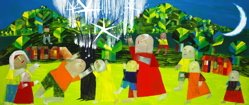
* The painting is the untitled contest piece by Liv Vinluan, which served as the inspiration for this year's children's story writing competition.
It was a close call between her story, Christopher Rosales' "May Naninirahang Gubat sa Aking Balat" and Raymond Falgui's "The Gray Lady, the Gray Girl and the Miracle of Colors."
The other finalists were "The Flower Girl" by Evita Guinto, "The Day the Colors Came" by Migs Marfori, and "Ang Regalo ni Nanay" by Alice Mallari.
The judges this year were writer Gary C. Devilles who teaches Philippine Literature, Art Appreciation, Political Economy of Mass Media in Ateneo de Manila University, De La Salle University, University of Sto. Tomas, and Far Eastern University; Dr. Dina Ocampo, current dean of the University of the Philippines College of Education and co-founder of Wordlab School Inc., a non-stock, non-profit institution that provides school program for children with dyslexia and other learning disabilities; and Gigo Alampay, executive director of CANVAS.
Congratulations to Frankie Torres and to all the other finalists! CANVAS wishes to also thank all the other writers who submitted entries. We look forward to everyone's continued participation and support in our future competitions.

BLUE STARS
by Francesca Nicole Torres
by Francesca Nicole Torres
This is a story about a lie that becomes a truth, if only one believes in it, and keeps believing, even when everything else says to do otherwise. It is a story about one of the most powerful things on earth.
In a time of war, there was a small village. It was hidden, cradled like a fragile baby bird, in a valley surrounded by steep mountains. Living in the village was like living in another world: a world of laughter, of song, and of joy. Men joked as they worked. Women sang as they did chores. And as for the children, the streets were filled with the sounds of their play, from morning till night.
But above all, what made this village very special were the flowers. The blooms grew wild in the fertile soil of the valley, explosions of color reaching towards the perfect patch of sun.
There were loud, red poppies; hardy, pink dog-roses; dainty, white lilies; and cheerful, yellow sunflowers.
But most of all, there was an endless carpet of small, blue stars, glistening in the grass like a constellation that had fallen out of the sky. They looked delicate and fragile, not wild and strong like the others. Many marveled at how healthy and how vibrant they were, with no one to care for them.
Well, that wasn't completely true. These flowers had one caretaker. She was a little girl. Her name was Nadia.
Ever since she was old enough to walk, Nadia had taken care of the little blue flowers. In the mornings, before the sun was up, she watered them. In the afternoons, she whispered to them. And at night, before she went to bed, she made sure to wish them sweet dreams. As long as she had her flowers, she was happy, and as long as she took care of them, they bloomed in abundance, for nothing makes a flower bloom more than love.
So Nadia’s joy became the joy of the village. And for a long time, everything was as it should be.
But this was a time of war, and though the steep mountains that surrounded the valley shielded the village for a time, they could not shield them forever. One moonless night, while Nadia was out in the flower fields, she heard it: a low rumbling, like the sound of distant drums. When she turned towards the direction of noise she saw, in the distance, the red glow of fire. Then there were more rumbles, getting louder and louder.
Nadia ran. She told her parents, who passed the news on to the rest of the village. From that moment, things started to change.
The frightened girl did not understand what those noises meant, but rest of the village did: the war was coming for them. They had hoped that the cradle of mountains would keep them safe until it was over, but that was before they had know there were bombs. Bombs could make mountains disappear in minutes.
There was no more laughter in the village now, no more time for singing or dancing or playing in the streets. Instead, there was panic. Villagers rushed to and fro, making preparations for their escape. Every day, they gathered supplies and made plans. Every night, they watched as the glow from the fires grew closer and closer, and prayed the bombs would pass them over.
There was no joy anymore...except for the flowers.
So strong was Nadia’s love for her flowers that no matter how scared she was, she could not forget them. So, in the mornings, before the sun was up, she still got up to water them. In the afternoons, she still whispered to them. And in the evenings, as the bombs went off and fire burned in the distance, she still wished them sweet dreams.
So her delicate flowers continued to bloom, full of life and joy, and for a moment, looking at them, the villagers could forget that there were bombs and gunshots and fires. They could forget that there was a war.
Then, one night, while Nadia was fast asleep, the war finally came.
There was no time to lose. As the flames began and the explosions shook the ground, the villagers ran for shelter in the mountains. Nadia spent the long night huddled in the dark, with her family, listening to roaring of the bombs and the crackling of the fire as it burnt through the village.
Finally, just before the sun came up, the bombs stopped and all was quiet. Slowly, the villagers made their way back to what remained of their home. They walked through the ruins in silence. Finally, they reached the fields.
The poppies were ashes, the dog-roses cinders, the lilies and sunflowers burnt to a crisp. But worst of all…
“My flowers…they’re gone!” Nadia cried. She ran through the burnt grass, looking for one petal, one shrub, one sign of life, one star…but there were none. No trace remained of the small blue flowers she had showered with love and care. Nadia fell on the ground and began to cry.
At the sight of this little girl, crying for what she had lost, the other villagers too started to weep. They mourned for the flowers. They mourned the village. But most of all, they mourned for the joy they felt would never come back.
For four days, there was only the sound of weeping in the village. But then, on the fifth day, just like before, Nadia got up before the sun rose, walked to field, and started to water the burnt earth, just as she had always done. In the afternoon, she whispered to what remained of the grass. And in the evening, she wished the field sweet dreams.
She did this again on the sixth day, and on the seventh day, and on the eighth day, and on the ninth day…
And on the tenth day, when she visited the field, she saw a faint glimmer of blue: a small blue star lay blooming in a patch of grass. She let out a cry of joy so loud that the whole village came running to the field to see what the noise was about. And when they saw it, the people cheered, and Nadia smiled.
They began to rebuild soon after. Men joked as they worked. Women sang as they helped build. And as for the children, the streets were filled with the sounds of their laughter again, from morning ‘till night.
And as for Nadia, and her flowers, well…
In a month, the grass was green again.
In two months, buds started to push up from the earth.
After a year had passed, from that one small blue flower, the field had grown again, and with it, joy finally returned to the village.
Many years have passed since then, and many things have passed with it. Nadia, once a little girl, has since grown up, and grown old, and gone. The village, too, is different: mountains have given way to roads, and what once was a small and hidden world is now a bustling town.
But the blue stars still remain, blooming like a constellation fallen from the sky. And, every day, a group of children water them in the morning, whisper to them in the afternoon, and wish them sweet dreams at night.
This is a story about a lie that becomes a truth, if only one believes in it, and keeps believing, even when all is burnt away and there seems to be nothing left. It is a story of love and loss and sadness and joy. It is a story about one of the most powerful things on earth.
It is a story of a little girl and her flowers.
It is a story of hope.
* The painting is the untitled contest piece by Liv Vinluan, which served as the inspiration for this year's children's story writing competition.
Subscribe to:
Posts (Atom)