Thursday, May 20, 2010


Last Chance
Think about jogging tonight or tomorrow morning at the UP Academic Oval. Those are your last best chances to see the art banners. They're going down later in the morning starting at around 10am. :-)
Tuesday, May 18, 2010
Joke the Vote

"In the most serious moments, trust Filipinos, acclaimed to be among the world’s happiest peoples, to joke and pun and laugh at themselves. The last elections, a historical moment for being the country’s first national automated balloting, sparked a bumper harvest of humorous tricks and treats across media old and new."
--Excerpt from a funny, revealing PCIJ piece.
Sunday, May 16, 2010
How We See Our Role Post-Elections
 Just a year after the EDSA Revolution of 1986, writer James Fallows wrote a highly controversial, widely read and still-discussed piece entitled A Damaged Culture - A New Philippines.
He pointed to a lack of nationalism among Filipinos, which he defined as the inability to "look beyond themselves rather than pursuing their own interests to the ruination of everyone else." The "national ambition is to change your nationality," he quoted, and he makes an overall argument that ours is a "damaged culture" characterized by "the tradition of political corruption and cronyism, the extremes of wealth and poverty, the tribal fragmentation, the local elite's willingness to make a separate profitable peace with colonial powers..." reflecting "a feeble sense of nationalism and a contempt for the public good."
In other words, he raised some very uncomfortable questions 23 years ago that, ironically, we are still asking today, as the son rises to take the place of his sainted mother.
It should be required reading for all Filipinos - even though Fallows is, of course, wrong.
There's no such thing as a damaged culture, just as it is wrong (and almost xenophobic) to even suggest that some cultures are superior or inferior to others. That's precisely what got World War II and apartheid into our history books.
What we do suffer from, as a country and as a people, is perception - both in terms of how the world sees us (an impoverished country with flawed institutions that consistently fails to live up to its potential); and in terms of how many of us see ourselves (increasingly defined by migrating overseas workers, corrupt politicians and a disaffected constituency).
It is not how CANVAS sees the Philippines and the Filipino people.
We are a proud nation with a rich heritage, and the fact that there are millions of us living abroad is not a liability or a source of shame, but a strength, source of hope and a testament to the resilience, adaptability and pride of the Filipino.
This is precisely why we have our Looking for Juan Program. By Looking for Juan, we affirm that, through art, we can, and must change this perception. Changing how the world sees us and how we see ourselves can redefine our history and destiny - again, as individuals and as a nation - in ways more tangible than people may think.
A positive view by the world leads to increased tourism and investments, more jobs, and a better future. Meanwhile, a positive view of ourselves leads to greater confidence, pride and hope.
As Manny Garibay recently put it to us, “Hope starts when people work on changing how we think. This is why art is important. Art is the expression of the ideas and aspirations of people and they form the foundation of culture.”
As the country transitions into a new administration and moves forward in a new, hopefully better direction, this is where we see our place... our role... Over the next few weeks and months, we will be announcing several new, more ambitious Looking for Juan initiatives.
We hope you will continue to support and join us.
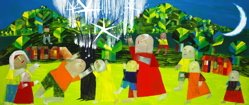
** Artwork:
“It is a picture of history taken from this point in time. It is bleak,” says Emmanuel Garibay. “Take it as a lament.”
The image came not too long after the floods. As a coincidence or effect, we see symbols of nationhood and of institutions in ruins. The Rizal monument, the Malacañang Palace, a church – symbols of tradition and patrimony – sink into what Garibay describes as “oblivion,” while a bushel of bananas (a banana economy) and a basketball (his metaphor for illusion and deception for an audience so easily entertained and distracted) are the only things remaining afloat. A man and woman – perhaps overseas Filipino workers, modern-day saviors – suffer crucified underneath a caricature of justice. But amid the chaos, Mabini’s expression is placid.
The image is a lament indeed -- for a people who have forgotten their nobility, for a state that knows not the meaning of “sovereignty,” and for a nation where social justice is compromised while corruption is rewarded -- just as it is a challenge to hope and to work towards the realization of hope.
--Excerpt from note accompanying the untitled piece shown above by Manny Garibay
5x4 feet, oil on canvas for Dekalogo (2010)
Thursday, May 13, 2010
Fair Warning
 We received a call from U.P. earlier this afternoon. They have an unanticipated need for some of the posts from which our art banners are hanging - could we take them down earlier than originally scheduled?
We're not yet sure exactly when, but we may have to honor their request. So one of these days, the banners could just be gone.
So come and visit and enjoy them while they're there. And if they're not, well, the original works will still be on display at the Vargas Museum until the end of May, regardless. :-)
Subscribe to:
Posts (Atom)